


AI Data Centers Move into Critical Infrastructure, Backed by Private Investment
The Korean government announced in February 2026, during the first Private Investment Project Review Committee meeting of the year, its plan to expand private investment into emerging sectors such as AI data centers and power infrastructure. Through initiatives including public participation infrastructure funds, the government aims to mobilize approximately KRW 100 trillion (USD ~75B) in private investment over the next five years. To support this initiative, the Ministry of Economy and Finance approved both the Private Investment Revitalization Plan and revisions to the Basic Plan for Private Investment Projects.
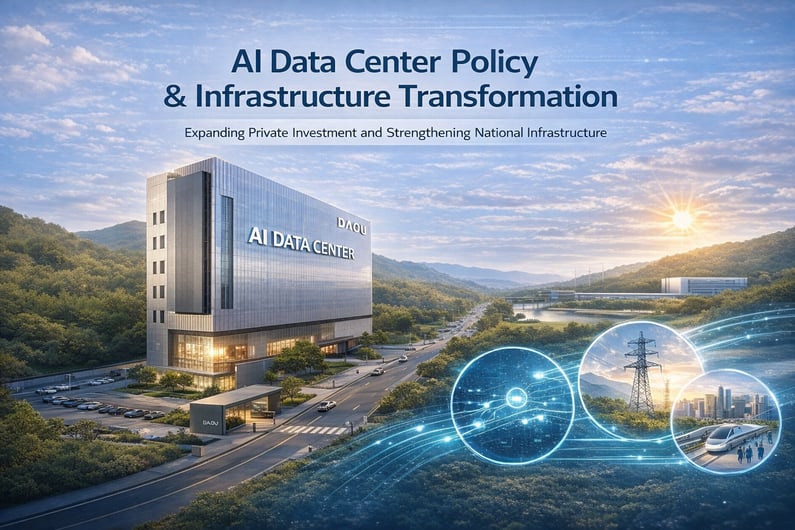
AI Data Centers Recognized as National Infrastructure
A key highlight of the policy is the official inclusion of AI data centers as part of Social Overhead Capital (SOC), establishing a legal and institutional framework for their development through private investment models. This marks a significant shift, recognizing data centers not merely as private IT facilities, but as essential national infrastructure critical to economic growth and industrial competitiveness.
While data centers have traditionally been viewed as tools for enterprise IT expansion, this policy elevates their role as foundational infrastructure supporting the broader digital economy. For operators, this creates new opportunities to participate in large-scale, government-linked infrastructure projects within a more stable and structured environment.
Improved Investment Structure and Expanded Business Opportunities
The policy also introduces meaningful changes to the investment structure. Previously, data center developers were largely responsible for financing and risk management independently. Going forward, projects are expected to adopt an SPC (Special Purpose Company)-based consortium model involving AI semiconductor companies, cloud service providers, telecom operators, construction firms, and financial institutions.
This approach enables risk-sharing while supporting larger-scale project development. More importantly, it facilitates integrated business models that combine technology, infrastructure, and operational capabilities. With the government signaling the launch of the first AI data center private investment project, similar initiatives are expected to follow, driving rapid growth in overall market investment.
Enhanced Revenue Stability and Shifting Location Strategies
The policy also contributes to improving revenue stability for data center operators. The government is currently reviewing a demand-side voucher program designed to support end users of data center services. This initiative is expected to reduce the burden of initial customer acquisition and provide a more predictable revenue base, addressing one of the key uncertainties in private infrastructure investments.
At the same time, location strategies are evolving. The government is encouraging data center development in regions with abundant renewable energy and lower land costs. This signals a shift away from the traditional Seoul metropolitan area-centric model toward a power-driven location strategy. Given the high energy consumption of AI data centers, access to stable and scalable power supply is expected to become a critical competitive factor, opening up new regional development opportunities for operators.
Power Infrastructure Expansion and Improved Business Environment
One of the most significant developments is the introduction of private participation in power grid development. Historically, power availability has been a major constraint for data center expansion. By allowing private investment in grid infrastructure, the policy is expected to accelerate power capacity expansion and improve accessibility for new data center projects.
In parallel, the government is implementing measures to streamline project execution, including simplified approval processes, shorter permitting timelines, and enhanced cost risk-sharing mechanisms to address construction cost inflation. These changes are expected to improve project execution speed and reduce financial uncertainty, ultimately strengthening the overall feasibility of large-scale data center developments.
A Structural Shift Toward Infrastructure-Driven Growth
Overall, this policy signals a structural transition of the data center industry—from standalone private developments to a core component of national infrastructure. With diversified investment structures, evolving location strategies, enhanced revenue stability, and improved power infrastructure, the industry is entering a phase where risks are reduced while growth opportunities are significantly expanded.
Data centers are no longer just real estate-driven assets; they are becoming critical infrastructure that underpins national competitiveness in the AI era. The introduction of private investment in AI data centers represents a pivotal starting point for this transformation and is expected to shape the future trajectory and growth of the data center market.
Discover More.
Join us as we take you through every step of the development of our state-of-the-art hyperscale data center in this blog. We loves to talk about what we do. Feel free to chat with our sales experts about data center, managed colocation, and connectivity.


Content is protected by copyright law and is owned by Daou Technology Inc
It is prohibited to modify or commercially use this content without prior consent.
Featured images via gettyimages.
References
